
How to Run a Book Club: A Simple Setup That Keeps Members Reading
Most book clubs don't end with an argument. They fade. The meetings get further apart, fewer people finish the book, someone stops replying to the date poll, and one day you realize nobody has suggested a new book in four months.
The clubs that last for years usually aren't the ones with the most passionate readers. They're the ones with a simple, predictable routine. This article is about building that routine.
Start small
The best size for a book club is somewhere between six and twelve people. Fewer than six and a couple of cancellations kill the meeting. More than twelve and the conversation splits into side chats, and the quieter members stop talking.
If more people want to join than you can comfortably fit, consider a second group rather than one big one. It's a good problem to have.
Decide what kind of club you are
It sounds obvious, but many clubs never say it out loud. Are you a literary club that wants to read the prize shortlists? A social club where the book is a reason to meet? A genre club for crime, fantasy or non-fiction? There's no wrong answer, but members who expected one thing and got another drift away quietly.
Write two sentences about it and put them somewhere everyone can see. It also makes inviting new people much easier.
Choosing books fairly
Book choice is where most friction comes from. A few approaches that work:
- Rotate the picker. Each month, a different member chooses. Simple and fair, and it exposes everyone to books they'd never pick.
- Shortlist and vote. The host suggests three books and the group votes. Slower, but people feel more ownership.
- Themed seasons. Four books on one theme, then a new theme. Helps when the group can't agree on anything.
Whatever you choose, set a deadline for the decision. A vote that runs for two weeks leaves nobody enough time to read.
A monthly rhythm
The clubs that last run on the same loop every month. Nobody has to think about what happens next.
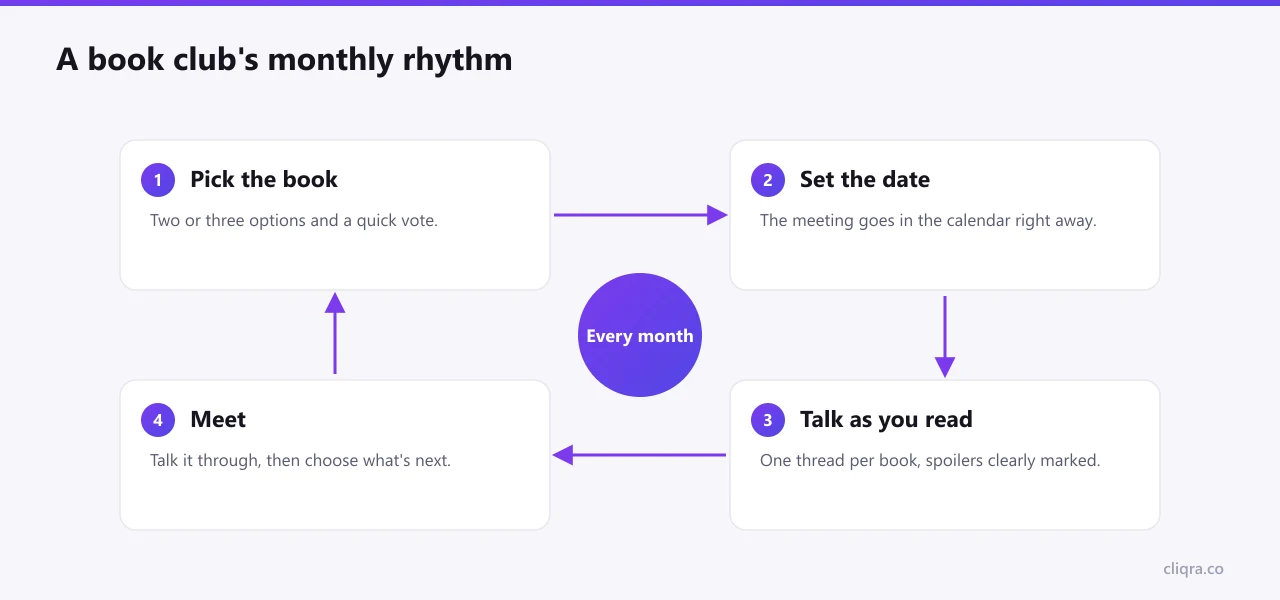
Pick the book, put the meeting date in the calendar straight away, talk a little while people are reading, then meet and choose the next one before everyone leaves. The last step is the important one: if the next book is decided at the meeting, the cycle never stalls.
Give the club one home
A book club has a surprising amount of information for such a small group: the current book, the meeting date and place, the list of past books, the suggestions for future ones, and whose turn it is to host.
In a group chat, all of that disappears within days. A small private space works much better. In Cliqra, the Book / Reading Club template gives you a page with the current book, a calendar, a discussion and a place for photos from meetings. Set it up once and it carries the club for years. If you're new to it, How to Create a Private Online Space for Your Group covers the basics.
Talking between meetings, without spoilers
Some members read the whole book in a weekend; others finish on the train to the meeting. Conversation between meetings is good, but it needs a little structure.
A practical approach: one thread per book in the discussion, with a simple rule. Say which chapter you're talking about at the start of the post ("Up to chapter 10:"), and keep anything about the ending for the meeting itself. Members reading slowly can still join in without having the twist ruined.
Titled posts in a Room's discussion are perfect for this, because each book gets its own page with replies underneath. See Using the Discussion for how they work.
Running the meeting itself
- Have a host, not a teacher. The host's job is to get the conversation started and make sure everyone gets a turn, not to lecture.
- Bring three questions. What surprised you? Which character would you not want to have dinner with? Would you recommend it, and to whom?
- Welcome people who didn't finish. They'll come next time if they don't feel judged this time.
- End with the next book. Before anyone reaches for their coat.
Keeping members engaged over time
After the first year, the main risk is routine turning into habit and habit into absence. Small things help:
- Keep a list of every book you've read, with a one-line verdict. It becomes the club's history, and new members love reading it.
- Post a photo from each meeting. It costs nothing and reminds people who missed it what they missed.
- Once or twice a year, do something different: a film adaptation night, an author event, a meeting in a different café.
For more ideas that work for any kind of group, see 5 Ways to Bring Your Community Together Online.
In short
A book club lasts when it's easy to keep going. Keep the group small, be clear about what kind of club you are, choose books fairly and quickly, run the same monthly loop, and give everything one home. The reading will take care of itself.